Tamara Hunter and Selina Ta explore the unfair trading practices bill introduced into the House of Representatives on 1 April 2026, considering the proposed laws and the changes since the exposure draft published in early February this year.
Overview
On 1 April 2026, Treasury introduced the Competition and Consumer Amendment (Unfair Trading Practices) Bill 2026 (Cth) (the Bill) into the House of Representatives. If passed, the new unfair trading practices laws will commence on 1 July 2027.
The Bill amends the Australian Consumer Law by introducing:
- A general prohibition on unfair trading practices towards consumers;
- Display requirements for transaction-based charges to protect against drip pricing and ensure potential buyers are aware of all mandatory charges during the purchase process; and
- Additional requirements for subscription contracts to protect against subscription practices that are detrimental to consumers and small businesses.
General prohibition on unfair trading practices
What is the general prohibition?
The Bill introduces a new general prohibition on engaging in unfair trading practices into the Australian Consumer Law (ACL). A person will engage in unfair trading practices where:
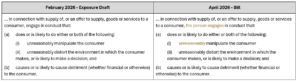
- Limb 1: Conduct occurs that does, or is likely to:
- manipulate the consumer; and/or
- unreasonably distort the environment in which the consumer makes, or is likely to make a decision; and
- Limb 2: the conduct is likely to cause detriment (financial or otherwise) to the consumer.
Changes since the February exposure draft
An exposure draft was released in February. The Bill differs from the exposure draft in some key ways:
1. Removal of ‘unreasonably’ in the ‘manipulate the consumer’ limb: The scope of the prohibition has expanded, as ‘unreasonably’ has been removed from definition, in relation to manipulation of the consumer. ‘Unreasonably’ remains in the ‘distortion of the consumer’s decision-making environment’ limb.
The Explanatory Memorandum explains: “Manipulation of a consumer is intended to capture wrongful interference with a consumer that results in a change in the consumer’s behaviour, decision-making or action that is against the consumer’s interests. It may involve the exploitation of common cognitive or behavioural biases and is not intended to require dishonesty. Manipulation of a consumer is also not intended to capture legitimate, reasonable or generally accepted marketing or sales practices.”
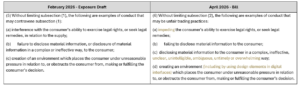
2. Additional examples inserted into the grey list: Subsection 28B(5) contains a ‘grey list’ of conduct that may be unfair trading practices. The Bill expands on the exposure draft, by:
- inserting the disclosure of material information to a consumer in an ‘unclear, unintelligible, ambiguous, untimely or overwhelming way’ as a potential contravention of the general prohibition, and
- including an example that the use of design elements in digital interfaces may create an environment that places unreasonable pressure on the consumer.
The general prohibition is intended to particularly address ‘dark patterns’ in digital interfaces, which are tactics that may impose obstacles which frustrate, exhaust or pressure consumers into unintended actions often without the consumer’s full awareness. This intention is reflected in the Explanatory Memorandum and the updated grey list in section 28B(6).[1]
3. The Bill introduces a new sub-section 28B(7): “Nothing in Part 3-1 (which is about unfair practices) limits by implication this section.”. This likely responds to feedback during the consultation period that the conduct intended to be covered by the general prohibition overlaps with the prohibitions in Part 3-1 of the ACL relating to false or misleading representations.
Drip pricing – Requirement to display transaction based charges
What is a transaction based charge?
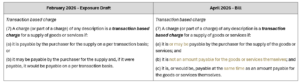
The display requirements apply when goods or services are offered for supply, and a transaction based charge would or may apply. A ‘transaction based charge’ is a charge that is not the amount payable for the goods or services themselves, and are payable as the same time as the amount payable for the goods or services themselves (but is not the amount payable itself).
The following information must be displayed:
- the amount of a transaction based charge (if it can be displayed at the same time the base price is displayed);
- information making it clear that the charge is a per transaction charge;
- whether the transaction based charge is or may be payable; and
- whether or not the base price includes the transaction based charge.
This information must be legibly, prominently and unambiguously displayed while the base price is displayed and in close proximity to the base price.
Changes since the February 2026 Exposure Draft
1. Wording change from ‘disclose’ to ‘display’: The exposure draft previously had ‘disclosure’ rather than ‘display’ requirements. All references to ‘disclose’ have been updated throughout the Bill accordingly.
2. Updated definition of transaction based charge: The updated definition is narrower, providing three requirements for a charge to be a ‘transaction based charge’.
3. Updated list of excluded charges: The updated list of excluded transaction based charges extend to part of a charge, and remove charges related to shipping goods (that is, shipping-related charges fall within transaction based charges).
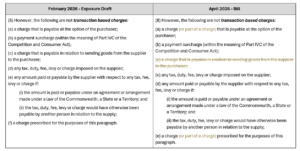
4. Prescribing excluded charges by regulation: Subsection 48A(9) provides for a mechanism where regulations may prescribe a charge as an excluded charge and may prescribe different circumstances for different charges. This is intended to ‘future proof’ the laws, by ensuring the government can make timely changes to exclude additional changes as needed, and ensure the display requirements are only imposed on intended charges.[2]
Subscription contracts
Requirements for subscription contracts
The Bill also introduces protections against subscription practices that are detrimental to consumers and small businesses. The proposed law requires subscription contract to:
- disclose key information about the contract when making the offer including:
- the fact that if entered, the relevant contract would be a subscription contract;
- any liabilities the party would incur under the contract (including the price of the subscription and other charges);
- the period of the contract (including information about the length of a free trial, the subscription period);
- information about contract renewal, extension, or continuation;
- notice required before the non-supplier party can end the contract;
- how the non-supplier party can end the contract;
- any other information prescribed by regulations.
- ensure there is an easy and straightforward way for subscribers to end their subscription that requires the subscriber to take only reasonably necessary steps.
Any disclosure must be provided in a legible, prominent and unambiguous manner, and any other manner as prescribed by regulations.
Changes since the February 2026 Exposure Draft
- Updated definition of subscription contract: The Bill’s definition of subscription contract captures indefinite period contracts, fixed period contracts, initial free period contracts, or initial discount period contracts that are not an excluded subscription contract. This differs from the previous approach to subscription contracts in the exposure draft, which included separate content requirements for each kind of subscription contract.
- Reduced scope of excluded subscription contracts: The Bill has reduced the types of excluded subscription contracts. A contract for supply of a public utility and a contract for the supply of healthcare products are no longer excluded. However, the Bill retains the power to prescribe additional excluded contracts in the future.
- Information requirements: The information requirements for subscription contracts in effect now apply to all subscription contracts, rather than separate combinations of content requirements for each kind of subscription contract.
- Removal of content of the statement: The Bill removes the previous ‘content of the statement’ requirement. The exposure draft required statements to include a statement that the contract would be for a subscription, and specify if the contract would be for a fixed or indefinite term, or if the contract would have a free trial period or promotional period.
- Prescribed exception: The Bill now allows for regulations to prescribe circumstances where the disclosure requirements for subscription contracts do not apply. Similar to proposed subsection 48A(9) in relation to transaction-based charges, this is intended to future proof the legislation to provide future flexibility.[3]
How does this impact small businesses?
Small businesses are protected against detrimental subscription practices under the new proposed laws.
As the Bill currently stands, the general prohibition on unfair trading practices does not apply to small businesses, because the prohibition is intended to combat unfair conduct towards consumers rather than business-to-business conduct. However, a media release published in March[4] and the Explanatory Memorandum demonstrate Treasury’s intention to consult on this further.
Small business can also take advantage of the drip pricing protections, unless the relevant offer is made exclusively to a body corporate.
Small businesses will also need to ensure they comply with the new regime.
What next?
The new laws are planned to take effect from 1 July 2027. The exposure draft was published on 9 February this year, with a short 14 day consultation period, closing submissions on 23 February 2026. The Bill was introduced swiftly less than 2 months later, with the next parliamentary sitting in mid-May.
Once enacted, these laws will impose increased compliance obligations on businesses that deal with consumers and small business. The introduction of these laws, particularly the general prohibition, aligns with the ACCC’s 2026-27 enforcement priority on manipulative and false practices in digital markets. Businesses will likely face heightened scrutiny in relation to their digital interfaces and their ability to manipulate or unreasonably distort the consumer’s decision-making environment.
In practice, affected businesses will need to review and amend their compliance programs, customer platforms and interfaces, customer onboarding processes, and selling and marketing practices more broadly, to ensure compliance and avoid contravention of the unfair trading practices general prohibition. Additionally, businesses will need to start preparing for the roll-out of relevant disclosures on their payment interfaces, IT systems and relevant customer-facing materials, to comply with the new requirements for transaction-based charges and subscription contracts.
Notes:
[1] See Explanatory Memorandum [1.30]: “While conduct in contravention of the general prohibition may be online or offline, the first limb of the definition of unfair trading practices is intended to particularly address conduct that involves the use of ‘dark patterns’ in digital interfaces, which can manipulate a consumer or unreasonably distort the environment in which a consumer makes, or is likely to make, a decision. These tactics are typically aimed at benefitting the person supplying or offering to supply the relevant goods or services by nudging or pressuring consumers into unintended actions, often without the consumer’s full awareness.”
[2] Explanatory Memorandum [1.70].
[3] See Explanatory Memorandum, [1.114], [1.139], [1.152].
[4] See Albanese Labor Government to extend unfair trading practice protections to small businesses | Treasury Ministers: “Treasury will consult this year on the design of protections for businesses, including on whether a principles‑based prohibition should apply and whether specific unfair trading practices should be targeted to protect small businesses.”
Image Credit: A person using a bank card to shop online, by Bogdan Hoyaux / Wikimedia Commons / Creative Commons 4.0 / Remixed to B&W and resized