The recent decision of the Federal Court of Australia in Bodum AG v H.A.G Import Corpn (Australia) Pty Ltd [2026] FCA 238 illustrates that even deliberate copying of a competitor’s design elements does not necessarily breach the Australian Consumer Law or amount to passing off.
Background
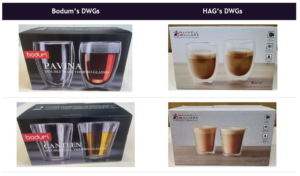
The dispute between kitchenware manufacturer Bodum AG (Bodum) and H.A.G Import Corpn (HAG), owner of the Maxwell & Williams brand, concerned the sale of double walled glasses (DWGs) which allow consumers to comfortably drink hot or cold beverages.
In the absence of a design registration, Bodum claimed that by copying the shape and design elements of its DWGs, HAG had engaged in misleading or deceptive conduct in breach of the Australian Consumer Law (ACL). Bodum also sought a declaration that HAG engaged in the tort of passing off.
It is noted that infringement of Bodum’s copyright in any design drawings for the DWGs was not alleged at trial. Even if Bodum was the owner of copyright in any such design drawings, by reason of the copyright / design overlap provisions in the Copyright Act 1968 (Cth) and the industrial application of the relevant design, it was not open to Bodum to claim that HAG had infringed any copyright in the design of the DWGs. Further, Bodum did not own any Australian trade mark registration for the shape of the DWGs. In the absence of copyright and any registered design or trade mark rights, Bodum’s case fell to be determined on the basis of claims under the ACL and passing off.
HAG admitted it intentionally adopted the shape and design features of Bodum’s DWGs but argued it did not do so in breach of the law. The Federal Court agreed.
Secondary reputation
To succeed in its passing off claim, Bodum needed to establish that consumers associated the shape of DWGs with Bodum (i.e. that Bodum had a ‘secondary reputation’ in that shape). This was also relevant, but not essential, to Bodum’s ACL claims.
Justice Raper found that this was not established, pointing to evidence that at the relevant time:
- Bodum’s DWGs formed part of an extensive range of Bodum kitchenware and glassware
- there was no difference in Bodum’s marketing budget and the time and effort it spent on DWGs as compared to its other products, and
- other DWGs with similar shape and design features had entered the Australian market.
Her Honour contrasted this with an earlier proceeding in which Bodum successfully established a ‘very significant secondary reputation’ in the shape of its Chambord coffee plunger.[1] A Full Court majority in that case considered ‘vast’ advertising revealed the distinctiveness of the coffee plunger shape,[2] separate from other marks, and found that there was ‘little more’ Bodum could have done to reach out to relevant consumers to hold out the Bodum Chambord coffee plunger as a product exhibiting a particular distinctive look.[3]
Intention in light of Bed Bath ‘N’ Table
In determining that HAG had not engaged in misleading or deceptive conduct, Justice Raper applied the recent High Court decision of Bed Bath ‘N’ Table [2025] HCA 50 (BBNT) which clarified how evidence of a party’s intention fits within the objective analysis required by s 18(1) ACL.
Recapping BBNT
As set out in our insight, BBNT confirmed that a party’s state of mind (such as an intention to copy) is an evidentiary factor that is relevant to whether s 18(1) ACL is contravened. A person’s intention to copy may support an inference about the likely effect of that person’s conduct on consumers and this is not confined to dishonest intent or ‘border line’ cases.[4] However, a party may adduce evidence to displace any such inference.
Applying BBNT
Applying the BBNT approach, Justice Raper treated HAG’s admission of copying and intent to take market share as relevant, but not determinative. Notably, it was HAG’s consistent use of branding and origin cues which displaced the inference that consumers would be misled by shape alone.
HAG made a conscious decision to etch the abbreviation ‘M&W’ on the bottom of its DWGs and include its word mark on its packaging. Justice Raper inferred that HAG did so on the basis that consumers would associate its brand with the products. Further, even if it could not be inferred that HAG intended for consumers to understand the abbreviated M&W mark, it could nevertheless be inferred that HAG used the mark to distinguish its products from those of Bodum.
In summary, while HAG had intended to copy Bodum’s shape and design features, the Court found that this did not mean it intended to mislead or deceive consumers.
This differed to the facts of BBNT, where the respondent’s ‘wilful blindness’ to the possibility of confusion weighed on the question of whether it was likely to deceive, and the respondent was unable to adduce convincing evidence explaining its borrowing of the applicant’s mark and store get up.
Key takeaways
The Federal Court’s decision demonstrates that it is possible to ‘sail close to the wind’, adopting design elements used by competitors, without passing off or contravening the ACL. While evidence of copying is relevant, it is not necessarily fatal. However, it is critical to obtain specialist legal advice before adopting this approach.
It is also important to note that different considerations will apply where other IP rights – such as registered trade marks, registered designs, patents or copyright – are in play.
[1] Bodum v DKSH Australia Pty Limited [2011] FCAFC 98, [197] (Greenwood J, Tracey J agreeing at [272]).
[2] Ibid [192].
[3] Ibid [186].
[4] Bed Bath ‘N’ Table Pty Ltd v Global Retail Brands Australia Pty Ltd [2025] HCA 50, [56] (Gageler CJ, Gordon, Edelman, Jagot and Beech-Jones JJ).